.............by those damned pesky mullet. I spent a couple of hours at my favourite river mark, at my favourite state of tide, using my favourite method (trotting on the pin) and, I had mullet in front of me but, do you think I could catch one of the buggers!! Not likely.
To be fair I did score a couple of sail away bites however, I don't think my 'eye' was 'In' because I failed to connect with either.
There does seem to be a lack of mullet in the river this year at least, that's how it appears, although I'm still seeing plenty under the boat in the marina. I'm not particularly worried nor can offer any reason why and I'm sure there'll be back in numbers next spring. Perceived population levels of mullet in the river do seem to fluctuate each year although its difficult to accurately gauge stock levels especially with the limited amount of time I spend fishing for them nowadays.
This trip did remind me of the frustrations I suffered back in the day when I fished solely for mullet during the summer months.
In a way, thank goodness I've diversified somewhat with my fishing as a few more days like today would probably find me tearing, what little hair I have left, out.
Friday, 31 October 2014

Saturday, 20 September 2014
6-9/9/14 Blue Shark
Finally, I've had an opportunity to drag the boat down to Falmouth , launching at Mylor,once again to chase blue shark-the first time this year. I had expected to be a 'pensioner' by now but things haven't quite panned out as planned so , at the moment, I'm still gainfully employed and to be honest,work is definitely scuttling my fishing plans for this year.
The intention was to stay in Falmouth for four or five days then, if the weather co-operated, move to Ilfracombe as the tides up there were favourable for porbeagle runs.
These shark trips take no small amount of preparation and I reckon I'd spent the best part of a whole day getting sorted for this one.
As a beginner sharker , you tend to absorb everything you are told or read about, and follow it to the letter . Having now had a few trips and gained a bit of experience, I've developed some ideas and made a few personal changes to bait and equipment that may not be the norm, nor to the liking of others out there in the U.K shark world.
Back in the heyday of South West shark fishing the would be 'sharker' could easily gather enough mackerel on 'the' day for their chumming needs. Nowadays things are a bit different and, judging by the general lack of mackerel showing anywhere, particularly in Sussex, an alternative needs to be found although, as will become apparent later in this blog entry, It's not all 'doom and gloom'.
Whatever the case I couldn't take the risk of relying on catching enough mackerel so had to take pre-prepared chum down with me. I've tweaked the original trout recipe somewhat by salting, instead of freezing it to keep it 'fresh' . I use the term 'fresh' quite loosely and perhaps 'preserved' would be a better term to use as it quite literally stinks to high heaven.
Basically the trout is salted as its gathered at the trout fishery and stored in one of those blue 65 litre drums with a sealed lid that you see everywhere, but can't seem to get hold of when you need one. Once it's full, I get a call from my 'agent' to come and collect it but it doesn't get anywhere near my van until it's had a thorough scrub with a stench masking kitchen surface cleaning solution, much to the amusement of my 'agent'. The drive home is always undertaken with a certain amount of trepidation.
If the neat chum is left to 'ferment' in the drum for a few weeks prior to processing, the salt tends to break down the fish (bones et al)and you are left with a substance of the consistency of porridge which can then easily (relatively speaking) be mixed with bran with no other preparation.
If you're in a rush then the trout need to be 'processed' ,which, in effect means 'mashed down' and by far the most effective , and quick way of doing this is by passing the fish through a domestic garden mulcher although the process is hideously messy and far from neighbour friendly.
Once mixed with bran the chum is stored in fifteen litre buckets with tightly sealed lids and usually, two of these will provide you with enough for a day's shark fishing. The sixty five litre drum of 'neat' trout when combined with a twenty kilo sack of bran produces about ninety litres, or six buckets of chum-enough for three days fishing.
For this trip I transported twelve buckets of chum and , as they weigh 35lb each, that was a considerable weight (420lb) to add to my trailered boat and needed careful consideration when loading and securing as there was absolutely no way I was going to lug that lot down in the back of my van, especially as it also served as my bedroom for the duration of the trip. In reality, once sealed in the buckets and cleaned, they emit relatively little odour and I shall be calling on my crew members to partake in the chum transport duties in the future.
After some experimentation,I've also tweaked the dispensing system by loading the chum into a tight weave vegetable sack which sits inside a chum bucket (again 15 litre). This has 20mm holes drilled into its sides. This regulates the chum to a steady flow and I've now learned to actually time how long each sack will last before it needs to be changed- about an hour at least.
I can usually get about three to four sacks from each bucket and by pre-packing the sacks in the buckets before each trip, and loading the chum bucket on the Warrior's extremely convenient transom deck, the mess inside the boat can be kept to an absolute minimum- a lesson I learned in the spring when it took nearly a day to clean up the boat afterwards with a pressure washer.The smell lingered for much longer.
Keeping the deck chum free also means its slip free . Get any of that oil rich muck on the deck and it becomes akin to an ice rink-less than ideal when tussling with a shark.
Salting, as opposed to freezing the chum means I can transport and store enough for extended trips lasting longer than just a couple of days and not rely on camp site freezers which would be anti social to say the least. I first tried this chum on last autumn's blue and porbeagle trips and it worked a treat attracting plenty of shark, and it also seems to keep well long term.
I had a couple of buckets left over from last year and the contents hadn't deteriorated in the slightest-the smell had lost none of it's 'tang' and the shark seem to love it as do tope, and I'm now wondering how many other applications it could be used for. My shallow water nocturnal conger outings immediately spring to mind.
On the tackle front, I'm now totally hooked (pun fully intended) on circle hooks for shark fishing. Having had such success with them on the blues last autumn, when I first started to use them, I continued with them on this trip and ALL the shark taken on them were neatly hooked in the corner of the mouth without fail.
I've also completely got the 'hang' of the unhook with a 'T' bar bringing the shark alongside the boat, a process which can be more difficult with a circle pattern of hook.
Basically it works like this; once the shark is alongside and played out ,hand the rod to your crew member and get them to bend into the shark applying as much tension as possible. The drag should be set accordingly in case the shark dives and the crew should grip the spool tightly with their thumb . Run your gloved hand along the wire back along the body of the shark (do not take a wrap.....ever) . This will turn the circle around and if the T bar is pulled in exactly the opposite direction , the hook releases quite easily. It takes a bit of practice but, by the end of this trip I had it mastered and was able to cleanly release each shark in seconds.
This process works a whole heap better if a wind-on leader is being used and here we court controversy again. The subject has been debated, sometimes quite heatedly, on internet forums and the like but speaking personally, I think they work a treat especially on a small boat.
In some respects regarding sea fishing tackle, we in the U.K are still in the dark ages but across the pond they've been using wind-on leaders and braid for shark fishing for years.
My own first batch of four wind-ons, having had some use, are now showing their age somewhat and although they're still perfectly usable will be replaced with some new versions of my own design as I've recently purchased the materials to construct them.
The 'originals' were built with 450lb mono which take up quite a bit of space on the reel spool and I'm not sure leaders of this guage are entirely necessary. The new batch will be built using 250lb hard commercial mono main bodies and hollow Dacron of 130lb-more than enough when you consider that the main line strength is 50lb.
On the subject of main line most U.S shark anglers I've spoken to on the internet use a braid main line with a mono top shot and wind-on leader and they're catching far bigger shark than we will ever see in the U.K. This means that they can use much smaller reels and this is something I intend to try next season even going so far as using an Avet MX for the blue shark.
To be honest, the conger I'm catching of late potentially give me far more trouble at the boat that a blue shark and I'm fishing the tiny MX with braid right through to a ten foot leader for them with absolutely no issues whatsoever.
Don't get me wrong,my Penn reels continue to give solid reliable service especially with the 'smooooothed out drags' but they are a bit of a 'lump'. Conversely, Dave's almost brand new Shimanos gave him so much grief on this trip with both reels displaying faulty drag mechs rendering them almost unfishable ,that they have been sent back to the supplier.
Another change I made on this trip was to put the boat on a pontoon mooring rather than recover her each day. I'm actually in two minds as to the advantages of this at Mylor because the slipway is so easy and quick to use and its certainly handy having the boat with you back at the superb camp site I use at Perranarworthal in the evenings to sort stuff out.
It costs but, the staff at Mylor marina do take good care of your boat . One morning the wind had picked up a bit and I'd been forced by space issues the previous evening to leave the boat on an outside pontoon-something I wasn't entirely comfortable with at the time.(Always follow your instincts) The staff had seen my 'mistake' and kindly moved my boat to a quieter mooring for me using an inflatable tug -superb service indeed.
And so to the fishing..........
Wayne joined me for the first two days with Dave arriving for days three and four and by day five, a brisk easterly had built up curtailing any more sharking activities.
The majority of the drifting was done on an ebbing tide with high water In the morning. This meant that I needed to head the boat out in a South Easterly direction to take full advantage of the drift and ensure that the boat continued to drift effectively for what would usually turn out to be eight or nine hours of fishing. I had been advised that the shark could be caught as close as six miles out but this was from someone who uses charter boats with a much shorter fishing day.
However, Andy Howell who runs a Warrior 165 in Cornwall as a charter and specialises in small boat sharking agreed with our long distance approach so the usual 240ft depth was sought and this meant a ten to twelve mile run out to sea and an obvious temperature rise on the fish finder.
The first three days found us floundering somewhat as the ebb died off pushing us closer in to land in a clockwise direction at very slow drift speeds towards the end of the day.
Whilst on the last day of the last trip in 2013 this worked a treat with six shark in very quick succession as the boat approached the Manacles, the same cannot be said for this year and indeed on day three, the boat ended up in a mere 60ft of water and so close to land that I called the day to a halt an hour or so early.
On day one when drifting effectively five shark came to the boat (four to my rods) with a couple approaching the six foot mark and the first one hitting my bait within minutes of starting to fish.
The same quick take occurred on day two to my rod and eight shark (four each) in total came to the boat - a new boat record for numbers of blue shark caught in a day.
Dave's first outing (day three) once again produced a very quick take but things slowed right off with just two shark (one each) to the boat and a couple of dropped baits.
On day four everything seemed perfect and i'll admit I was brimming with confidence. I'd punched out just a tad further to ensure an effective all day long drift and this did indeed happen. The slight easterly assisted us by speeding up the drift slightly and the chum trail was absolutely spot on, the boat holding so steady it did not need correcting even once during the day to prevent the lines tangling but................just one shark took my bait all day long and this one made an effective escape anyway. Bugger. I don't think I've ever felt so let down but, that is fishing.
All of the fifteen shark were fat and fit, probably satiated on mackerel, giving us far better fights than those caught last year and I suppose half a dozen were in the six foot range.
As for other life forms in the water well, what can I say about the mackerel. They were absolutely everywhere and not once did we need to resort to frozen hook baits. To be honest we could have relied on them easily to provide enough chum if only we'd known.
At the end of day two Wayne even filled a cool box up to take home-a very wise move indeed, as well as snaffling a p.b red gurnard on a baited feather.
Wildlife highlight was the spectacular sight of a pod of bottle nosed dolphins literally smashing a shoal of baitfish, breaching fully on occasion with a superb view of a good ten footer which swam right under my hull in the crystal clear water.
As mentioned earlier by day five the easterly wind had picked up sufficiently for us to curtail sharking and give the harbour a try. Unfortunately that wind funnelled up the valleys and even quite high up the inlets conditions were too difficult to fish effectively but we'd had a good look around anyway and the scenery is certainly pleasing on the eye.
A very enjoyable trip indeed but whether I'll return to Falmouth next year will remain to be seen as I'm starting to think about new destinations for future blue shark trips.
Unfortunately, although I towed the boat up to Ilfracombe after leaving Mylor to visit my son Jack and inspect his new workshop, the easterly winds persisted and I was advised by Nick (Pix) my local North Devon contact, that it wasn't going to happen this time so the porbeagles will have to wait for another day, and another tide.


http://youtu.be/WwkjfkFlKBg
The intention was to stay in Falmouth for four or five days then, if the weather co-operated, move to Ilfracombe as the tides up there were favourable for porbeagle runs.
These shark trips take no small amount of preparation and I reckon I'd spent the best part of a whole day getting sorted for this one.
As a beginner sharker , you tend to absorb everything you are told or read about, and follow it to the letter . Having now had a few trips and gained a bit of experience, I've developed some ideas and made a few personal changes to bait and equipment that may not be the norm, nor to the liking of others out there in the U.K shark world.
Back in the heyday of South West shark fishing the would be 'sharker' could easily gather enough mackerel on 'the' day for their chumming needs. Nowadays things are a bit different and, judging by the general lack of mackerel showing anywhere, particularly in Sussex, an alternative needs to be found although, as will become apparent later in this blog entry, It's not all 'doom and gloom'.
Whatever the case I couldn't take the risk of relying on catching enough mackerel so had to take pre-prepared chum down with me. I've tweaked the original trout recipe somewhat by salting, instead of freezing it to keep it 'fresh' . I use the term 'fresh' quite loosely and perhaps 'preserved' would be a better term to use as it quite literally stinks to high heaven.
Basically the trout is salted as its gathered at the trout fishery and stored in one of those blue 65 litre drums with a sealed lid that you see everywhere, but can't seem to get hold of when you need one. Once it's full, I get a call from my 'agent' to come and collect it but it doesn't get anywhere near my van until it's had a thorough scrub with a stench masking kitchen surface cleaning solution, much to the amusement of my 'agent'. The drive home is always undertaken with a certain amount of trepidation.
If the neat chum is left to 'ferment' in the drum for a few weeks prior to processing, the salt tends to break down the fish (bones et al)and you are left with a substance of the consistency of porridge which can then easily (relatively speaking) be mixed with bran with no other preparation.
If you're in a rush then the trout need to be 'processed' ,which, in effect means 'mashed down' and by far the most effective , and quick way of doing this is by passing the fish through a domestic garden mulcher although the process is hideously messy and far from neighbour friendly.
Once mixed with bran the chum is stored in fifteen litre buckets with tightly sealed lids and usually, two of these will provide you with enough for a day's shark fishing. The sixty five litre drum of 'neat' trout when combined with a twenty kilo sack of bran produces about ninety litres, or six buckets of chum-enough for three days fishing.
For this trip I transported twelve buckets of chum and , as they weigh 35lb each, that was a considerable weight (420lb) to add to my trailered boat and needed careful consideration when loading and securing as there was absolutely no way I was going to lug that lot down in the back of my van, especially as it also served as my bedroom for the duration of the trip. In reality, once sealed in the buckets and cleaned, they emit relatively little odour and I shall be calling on my crew members to partake in the chum transport duties in the future.
After some experimentation,I've also tweaked the dispensing system by loading the chum into a tight weave vegetable sack which sits inside a chum bucket (again 15 litre). This has 20mm holes drilled into its sides. This regulates the chum to a steady flow and I've now learned to actually time how long each sack will last before it needs to be changed- about an hour at least.
I can usually get about three to four sacks from each bucket and by pre-packing the sacks in the buckets before each trip, and loading the chum bucket on the Warrior's extremely convenient transom deck, the mess inside the boat can be kept to an absolute minimum- a lesson I learned in the spring when it took nearly a day to clean up the boat afterwards with a pressure washer.The smell lingered for much longer.
Keeping the deck chum free also means its slip free . Get any of that oil rich muck on the deck and it becomes akin to an ice rink-less than ideal when tussling with a shark.
Salting, as opposed to freezing the chum means I can transport and store enough for extended trips lasting longer than just a couple of days and not rely on camp site freezers which would be anti social to say the least. I first tried this chum on last autumn's blue and porbeagle trips and it worked a treat attracting plenty of shark, and it also seems to keep well long term.
I had a couple of buckets left over from last year and the contents hadn't deteriorated in the slightest-the smell had lost none of it's 'tang' and the shark seem to love it as do tope, and I'm now wondering how many other applications it could be used for. My shallow water nocturnal conger outings immediately spring to mind.
On the tackle front, I'm now totally hooked (pun fully intended) on circle hooks for shark fishing. Having had such success with them on the blues last autumn, when I first started to use them, I continued with them on this trip and ALL the shark taken on them were neatly hooked in the corner of the mouth without fail.
I've also completely got the 'hang' of the unhook with a 'T' bar bringing the shark alongside the boat, a process which can be more difficult with a circle pattern of hook.
Basically it works like this; once the shark is alongside and played out ,hand the rod to your crew member and get them to bend into the shark applying as much tension as possible. The drag should be set accordingly in case the shark dives and the crew should grip the spool tightly with their thumb . Run your gloved hand along the wire back along the body of the shark (do not take a wrap.....ever) . This will turn the circle around and if the T bar is pulled in exactly the opposite direction , the hook releases quite easily. It takes a bit of practice but, by the end of this trip I had it mastered and was able to cleanly release each shark in seconds.
This process works a whole heap better if a wind-on leader is being used and here we court controversy again. The subject has been debated, sometimes quite heatedly, on internet forums and the like but speaking personally, I think they work a treat especially on a small boat.
In some respects regarding sea fishing tackle, we in the U.K are still in the dark ages but across the pond they've been using wind-on leaders and braid for shark fishing for years.
My own first batch of four wind-ons, having had some use, are now showing their age somewhat and although they're still perfectly usable will be replaced with some new versions of my own design as I've recently purchased the materials to construct them.
The 'originals' were built with 450lb mono which take up quite a bit of space on the reel spool and I'm not sure leaders of this guage are entirely necessary. The new batch will be built using 250lb hard commercial mono main bodies and hollow Dacron of 130lb-more than enough when you consider that the main line strength is 50lb.
On the subject of main line most U.S shark anglers I've spoken to on the internet use a braid main line with a mono top shot and wind-on leader and they're catching far bigger shark than we will ever see in the U.K. This means that they can use much smaller reels and this is something I intend to try next season even going so far as using an Avet MX for the blue shark.
To be honest, the conger I'm catching of late potentially give me far more trouble at the boat that a blue shark and I'm fishing the tiny MX with braid right through to a ten foot leader for them with absolutely no issues whatsoever.
Don't get me wrong,my Penn reels continue to give solid reliable service especially with the 'smooooothed out drags' but they are a bit of a 'lump'. Conversely, Dave's almost brand new Shimanos gave him so much grief on this trip with both reels displaying faulty drag mechs rendering them almost unfishable ,that they have been sent back to the supplier.
Another change I made on this trip was to put the boat on a pontoon mooring rather than recover her each day. I'm actually in two minds as to the advantages of this at Mylor because the slipway is so easy and quick to use and its certainly handy having the boat with you back at the superb camp site I use at Perranarworthal in the evenings to sort stuff out.
It costs but, the staff at Mylor marina do take good care of your boat . One morning the wind had picked up a bit and I'd been forced by space issues the previous evening to leave the boat on an outside pontoon-something I wasn't entirely comfortable with at the time.(Always follow your instincts) The staff had seen my 'mistake' and kindly moved my boat to a quieter mooring for me using an inflatable tug -superb service indeed.
And so to the fishing..........
Wayne joined me for the first two days with Dave arriving for days three and four and by day five, a brisk easterly had built up curtailing any more sharking activities.
The majority of the drifting was done on an ebbing tide with high water In the morning. This meant that I needed to head the boat out in a South Easterly direction to take full advantage of the drift and ensure that the boat continued to drift effectively for what would usually turn out to be eight or nine hours of fishing. I had been advised that the shark could be caught as close as six miles out but this was from someone who uses charter boats with a much shorter fishing day.
However, Andy Howell who runs a Warrior 165 in Cornwall as a charter and specialises in small boat sharking agreed with our long distance approach so the usual 240ft depth was sought and this meant a ten to twelve mile run out to sea and an obvious temperature rise on the fish finder.
The first three days found us floundering somewhat as the ebb died off pushing us closer in to land in a clockwise direction at very slow drift speeds towards the end of the day.
Whilst on the last day of the last trip in 2013 this worked a treat with six shark in very quick succession as the boat approached the Manacles, the same cannot be said for this year and indeed on day three, the boat ended up in a mere 60ft of water and so close to land that I called the day to a halt an hour or so early.
On day one when drifting effectively five shark came to the boat (four to my rods) with a couple approaching the six foot mark and the first one hitting my bait within minutes of starting to fish.
The same quick take occurred on day two to my rod and eight shark (four each) in total came to the boat - a new boat record for numbers of blue shark caught in a day.
Dave's first outing (day three) once again produced a very quick take but things slowed right off with just two shark (one each) to the boat and a couple of dropped baits.
On day four everything seemed perfect and i'll admit I was brimming with confidence. I'd punched out just a tad further to ensure an effective all day long drift and this did indeed happen. The slight easterly assisted us by speeding up the drift slightly and the chum trail was absolutely spot on, the boat holding so steady it did not need correcting even once during the day to prevent the lines tangling but................just one shark took my bait all day long and this one made an effective escape anyway. Bugger. I don't think I've ever felt so let down but, that is fishing.
All of the fifteen shark were fat and fit, probably satiated on mackerel, giving us far better fights than those caught last year and I suppose half a dozen were in the six foot range.
As for other life forms in the water well, what can I say about the mackerel. They were absolutely everywhere and not once did we need to resort to frozen hook baits. To be honest we could have relied on them easily to provide enough chum if only we'd known.
At the end of day two Wayne even filled a cool box up to take home-a very wise move indeed, as well as snaffling a p.b red gurnard on a baited feather.
Wildlife highlight was the spectacular sight of a pod of bottle nosed dolphins literally smashing a shoal of baitfish, breaching fully on occasion with a superb view of a good ten footer which swam right under my hull in the crystal clear water.
As mentioned earlier by day five the easterly wind had picked up sufficiently for us to curtail sharking and give the harbour a try. Unfortunately that wind funnelled up the valleys and even quite high up the inlets conditions were too difficult to fish effectively but we'd had a good look around anyway and the scenery is certainly pleasing on the eye.
A very enjoyable trip indeed but whether I'll return to Falmouth next year will remain to be seen as I'm starting to think about new destinations for future blue shark trips.
Unfortunately, although I towed the boat up to Ilfracombe after leaving Mylor to visit my son Jack and inspect his new workshop, the easterly winds persisted and I was advised by Nick (Pix) my local North Devon contact, that it wasn't going to happen this time so the porbeagles will have to wait for another day, and another tide.
http://youtu.be/WwkjfkFlKBg
Tuesday, 16 September 2014
31/8/14 Brian's Boat
A thoroughly enjoyable day afloat with my marina neighbour, Brian on board his very capable Orkney Fastliner 19 'Marruig'.
The fishing, to be perfectly honest, was pretty slow despite our best efforts to get out of the harbour early that morning, and the weather wasn't particularly kind either but a smattering of interesting species turned up including this red mullet-the first I have ever seen.


 Bream plaice, and gurnard made up the catch and as always, Brian's razor wit ensured that the trip was far from boring.
The fishing, to be perfectly honest, was pretty slow despite our best efforts to get out of the harbour early that morning, and the weather wasn't particularly kind either but a smattering of interesting species turned up including this red mullet-the first I have ever seen.
Sunday, 14 September 2014
29/8/14 Hamble Mullet
A very pleasant day's fishing at Mercury Marina on the River Hamble chasing thick lipped mullet on the bread feeder.
Two rods were employed along with a bucket full of liquidised white bread but only one bite all day resulted in this small mullet of about a pound. It certainly seemed as if the fish were absent as none of the usual giveaway whelms and surface movement was apparent, and I was also quite surprised that no school bass were about either.
In fact , the 'word on the street' is that mullet numbers generally are down everywhere this year but I suspect its only a temporary situation and , as occurs with many species, we do see the odd year when stocks appear to be low.
This venue has produced well for me in the past and is one of the few mullet locations that I've fished where you can comfortably leger for a few hours over the twin high tides that occur because of the Isle Of Wight.
With September just around the corner, the best time of year to target these fish approaches and I suspect I'll be having a go at them on the Arun before the autumn is finished.


Two rods were employed along with a bucket full of liquidised white bread but only one bite all day resulted in this small mullet of about a pound. It certainly seemed as if the fish were absent as none of the usual giveaway whelms and surface movement was apparent, and I was also quite surprised that no school bass were about either.
In fact , the 'word on the street' is that mullet numbers generally are down everywhere this year but I suspect its only a temporary situation and , as occurs with many species, we do see the odd year when stocks appear to be low.
This venue has produced well for me in the past and is one of the few mullet locations that I've fished where you can comfortably leger for a few hours over the twin high tides that occur because of the Isle Of Wight.
With September just around the corner, the best time of year to target these fish approaches and I suspect I'll be having a go at them on the Arun before the autumn is finished.
Sunday, 17 August 2014
15/8/14 A Change Of Tide.
I've been receiving a bit of well meant 'stick' on the Facebook of late after posting pictures of the conger that I've been catching recently. I was 'criticised' for not wearing a lifeline in the pictures and not attaching myself to the boat especially as the fishing was in darkness.
Usually, I accept any advice readily but in this case feel the need to justify my actions and explain why I think a lifeline would be a hindrance, if not downright dangerous in this situation though of course, the reader should carry out an evaluation of the risks themselves, and make their own mind up.
My Warrior is a BIG small boat but, it is still a 'small' boat with relatively limited deck space. Bring a 7 foot long conger on board and suddenly it becomes a very crowded place indeed.
Crews that I've taken conger fishing have all been excellent at keeping the deck completely clutter free and following instructions to the letter when necessary, and the same can be said when tope and shark fishing. With an element of forward planning and having kit, such as gloves, weigh sling, pliers at the ready, everything so far , has gone very smoothly with all the bigger fish species I've had on board.
What tends to happen , especially with conger, is that there is a lot of strategic shuffling around the cockpit, swapping sides to balance the boat, manoeuvring to take pictures, measuring, weighing and of course returning the fish.
A 50lb plus conger needs two people to handle it safely in this environment. In this situation I'm of the opinion, that any form of lifeline or tether would be a real pain in the back side and more than likely be a trip hazard.
What I suggest is that people try it for themselves before drawing any conclusions and I don't mean conger fishing in a charter boat with an experienced skipper on board!
The Warrior has excellent freeboard (one of the reasons I chose the boat) and I'm only fishing for these conger in calm sea conditions, both of which greatly reduce the chance of going over the side but, there's always THAT chance and I will admit that I SHOULD be wearing a lifejacket and make no excuses whatsoever that I'm not.(Don't do as I do, do as I say)
The boat is equipped with a full compliment of life jackets but personally, I only wear one when I feel that it is necessary-perhaps when sea conditions 'kick up' and I've only ever felt the need to attach myself to the boat with a lifeline on one occasion-when motoring home alone in a heavy sea in my Orkney 520.This may be the wrong attitude but I'll leave the reader to decide on this issue.
I wonder how many regular small boat anglers actually wear a life jacket all the time.
The biggest problem the Facebook comments have created for me, is that my better half now worries about me being out fishing at night and indeed, on the last occasion lost sleep over it. She will get over it but she will take some convincing.
The 'real' problem at night is being able to see when you're motoring, and avoid hazards -usually pot markers. To be honest, this is where the small boat ,where you can stand to helm and look over the cuddy , really scores. I've been out in bigger cabin boats at night and its far more difficult to see what's ahead through a screen or window.
In the Warrior , once your night vision kicks in you can actually see very clearly indeed and again, with reduced travelling speeds I've not had any problems on night trips despite the plethora of badly marked 'junk' out there.
If I do accidentally pick up a pot line, which I have done during daylight, its easy to just trim up the outboard and set it free. Should a line become tangled with my prop, I always carry two very strong zip ties ready looped up so I can quickly attach my bait knife to my boat hook and safely cut the rope without leaning out over the stern-useful tip this one.
Anyway enough of that safety stuff-what of the fishing. I took Brian for a return trip to my conger mark this evening but on a much bigger tide that was flooding on the mark during the session. Despite the increased size of the tide the flow was greatly reduced compared to recent trips though with very little breeze, the boat held steady and I was still able to position her accurately.
The first anchorage produced very few bites at all although I did pick up a nice undulate ray on a the half mackerel bait.
With things a bit slow in comparison to what we'd been accustomed to of late, I decided to move the boat to a different part of the mark and anchor with baits fishing over what was obviously VERY rough, snaggy ground. This proved to be a wise move and three congers were brought to the boat in quick succession ,though nothing particularly big-upper doubles maybe.
For some reason the flood tide at this mark appears to be less productive despite the fact that, on the first anchorage, we had a shark chum sack pinned to the sea bed, and Brian's excellent bait dropper was used to deposit a few free offerings.
I suspect that the steadier flows that come with ebbing tides here are more effective at getting scent from the baits into the eel's lairs, or maybe there are just more eels on that side of the mark. At the moment, this is all pure conjecture and a few more tides need to be fished before any conclusions can be drawn however, if the evenings are calm when the tides come 'right' next week I suspect we'll be back for another go. I need to get Brian that big eel.
I'm hoping this post might generate a bit of discussion or some comments??? Please feel free, I'd like to know who is out there.
Usually, I accept any advice readily but in this case feel the need to justify my actions and explain why I think a lifeline would be a hindrance, if not downright dangerous in this situation though of course, the reader should carry out an evaluation of the risks themselves, and make their own mind up.
My Warrior is a BIG small boat but, it is still a 'small' boat with relatively limited deck space. Bring a 7 foot long conger on board and suddenly it becomes a very crowded place indeed.
Crews that I've taken conger fishing have all been excellent at keeping the deck completely clutter free and following instructions to the letter when necessary, and the same can be said when tope and shark fishing. With an element of forward planning and having kit, such as gloves, weigh sling, pliers at the ready, everything so far , has gone very smoothly with all the bigger fish species I've had on board.
What tends to happen , especially with conger, is that there is a lot of strategic shuffling around the cockpit, swapping sides to balance the boat, manoeuvring to take pictures, measuring, weighing and of course returning the fish.
A 50lb plus conger needs two people to handle it safely in this environment. In this situation I'm of the opinion, that any form of lifeline or tether would be a real pain in the back side and more than likely be a trip hazard.
What I suggest is that people try it for themselves before drawing any conclusions and I don't mean conger fishing in a charter boat with an experienced skipper on board!
The Warrior has excellent freeboard (one of the reasons I chose the boat) and I'm only fishing for these conger in calm sea conditions, both of which greatly reduce the chance of going over the side but, there's always THAT chance and I will admit that I SHOULD be wearing a lifejacket and make no excuses whatsoever that I'm not.(Don't do as I do, do as I say)
The boat is equipped with a full compliment of life jackets but personally, I only wear one when I feel that it is necessary-perhaps when sea conditions 'kick up' and I've only ever felt the need to attach myself to the boat with a lifeline on one occasion-when motoring home alone in a heavy sea in my Orkney 520.This may be the wrong attitude but I'll leave the reader to decide on this issue.
I wonder how many regular small boat anglers actually wear a life jacket all the time.
The biggest problem the Facebook comments have created for me, is that my better half now worries about me being out fishing at night and indeed, on the last occasion lost sleep over it. She will get over it but she will take some convincing.
The 'real' problem at night is being able to see when you're motoring, and avoid hazards -usually pot markers. To be honest, this is where the small boat ,where you can stand to helm and look over the cuddy , really scores. I've been out in bigger cabin boats at night and its far more difficult to see what's ahead through a screen or window.
In the Warrior , once your night vision kicks in you can actually see very clearly indeed and again, with reduced travelling speeds I've not had any problems on night trips despite the plethora of badly marked 'junk' out there.
If I do accidentally pick up a pot line, which I have done during daylight, its easy to just trim up the outboard and set it free. Should a line become tangled with my prop, I always carry two very strong zip ties ready looped up so I can quickly attach my bait knife to my boat hook and safely cut the rope without leaning out over the stern-useful tip this one.
Anyway enough of that safety stuff-what of the fishing. I took Brian for a return trip to my conger mark this evening but on a much bigger tide that was flooding on the mark during the session. Despite the increased size of the tide the flow was greatly reduced compared to recent trips though with very little breeze, the boat held steady and I was still able to position her accurately.
The first anchorage produced very few bites at all although I did pick up a nice undulate ray on a the half mackerel bait.
With things a bit slow in comparison to what we'd been accustomed to of late, I decided to move the boat to a different part of the mark and anchor with baits fishing over what was obviously VERY rough, snaggy ground. This proved to be a wise move and three congers were brought to the boat in quick succession ,though nothing particularly big-upper doubles maybe.
For some reason the flood tide at this mark appears to be less productive despite the fact that, on the first anchorage, we had a shark chum sack pinned to the sea bed, and Brian's excellent bait dropper was used to deposit a few free offerings.
I suspect that the steadier flows that come with ebbing tides here are more effective at getting scent from the baits into the eel's lairs, or maybe there are just more eels on that side of the mark. At the moment, this is all pure conjecture and a few more tides need to be fished before any conclusions can be drawn however, if the evenings are calm when the tides come 'right' next week I suspect we'll be back for another go. I need to get Brian that big eel.
I'm hoping this post might generate a bit of discussion or some comments??? Please feel free, I'd like to know who is out there.
13/8/14 200 hours.
I've now owned my Warrior 175 Export 'Jupiter's Moon' for 21 months and during that time have completed 84 trips in her and, according to the trip meter on my GPS, I have travelled over 1800 nautical miles !!!
I estimate the fuel usage to be something around a litre per nautical mile but easily achieve less than this (better) when i'm able to run quickly on a flat sea. There can't be many vehicles that use less fuel the faster you travel!
One useful little device that is included with my Suzuki main engine, is that it tells you when it needs a scheduled oil change. Every time you start the engine, the tachometer cleverly indicates how many hours the engine has run and, when a service is due, the oil pressure warning light flashes intermittently and a buzzer sounds.
I've been watching the tacho closely on recent trips as it approached the 200hour mark and on the last trip the warning signals were activated and it was time to drag her out for a service. Amusingly, and because i'd failed to read the operators manual properly, the last time this notification system activated at 100 hours i thought there was something seriously wrong with the engine and stopped it dead whilst at sea. It took a while for the penny to drop and i realised it was just asking for a 'transfusion'.
The 200 hour service requires replacement of the pump impeller as well as the full 'works'.
In order to maintain the warranty on the 'big' Suzuki the service must be carried out by an approved mechanic and this costs big money. I've no complaints about the marine engineer who has serviced this engine so far but, like all marine engineers, he's not cheap at all so I decided to take a calculated risk,bin the warranty and do the servicing myself.
Whilst i don't have any formal mechanical traning, i've always serviced my own road vehicles, have the necessary tools and feel competent enough to do so however, I would never touch someone else's boat nor recommend that anyone does it themselves unless they have a modicum of 'know how'. Outboard motors are very simple machines indeed and my Suzuki is no different to most-it's basically a four cylinder,twin cam 2 litre car engine which sits vertically and is attached directly to rudimentary 'gearbox'(the outboard leg)
According to the schedule in the handbook, the service includes a series of inspections and the changing of, spark plugs, engine oil and filter, gearbox oil and impeller. I used genuine Suzuki, or OEM specified parts throughout and despite being extremely cautious and thorough, the whole service took me about three hours in total and probably saved me about £300 in costs.
 There were absolutely no glitches in the process but, its worth passing on a couple of pointers here to those wishing have a go themselves.
A basic tool kit including socket set will suffice but you'll need a filter strap wrench and a 6mm allan socket for the oil drain plug.
 Warm the engine thoroughly before draining the oil (ears and hose line attached of course).
 This thins the oil and ensures all the dirty stuff gets drained out. You can see how black it is in the picture.
Make sure you have a big enough drain tray for the engine oil-there are 5.5 litres of it in the 100 hp Suzuki.

There are six bolts holding the leg in place and one of them is accessed by removing the trim tab. Mark the trim tab's position before dismantling otherwise when you put it all back together ,your boat will go around in circles!!
 The leg is heavy and unwieldy so be careful when removing it and place it on something protective(i used a sheet of plywood) and don't forget to disconnect and reconnect on assembly the speed indicator tube.
 The impeller housing has four bolts and its worth checking the internal faces for wear and replacing if necessary. Mine were still like new even though i don't regularly flush with fresh water however, i do run my engine periodically even if its not being used due to bad weather and always run it in 'clear' water if I've come in from a trip when the marina is shallow, or its being dredged. The key is to flush out any sediment that might settle in the cooling system .
Get a replacement gasket for the pump housing as it's very delicate and could be damaged when dismantling.
When reassembling the impeller and housing apply a thin coat of marine grease to the components and gently rotate the drive shaft in the correct direction to aid assembly. It also worth greasing the drive shaft, and gear shifter splines.
 Get a bespoke hand pump and adaptor to fill up the gearbox oil. They are very cheap , worth their weight in gold and usually come in a kit with a litre of EP 90 and an impeller.
Make sure you get the right impeller by quoting the engine serial number when ordering. I got sent the wrong one initially. Doh.
 Get an extra litre of EP 90 gear oil in case you spill any and, rather inconveniently, the leg takes 1.1 litres anyway.
Keep your 'old' spark plugs as spares (mine were still like new).
The only job i didn't do was to check the valve clearances as I neglected to order a spare gasket and didn't want to risk relying on the old one to reseal. This job will be done when she next comes out for a shark run which should be in a month's time.
Overall the process was pretty straightforward and enabled me to get a good look at my engine and see what everything does and how it should function.
One issue I did manage to address was the route of the fuel line inside the engine cowling which caused me so many problems just over a year ago. In a nutshell, the fuel line is routed too close to the gear selector cable bracket and is prone to being worn away with use. It had actually worn through a year ago causing a fuel leak, and was replaced with a heavier duty line at the time.
On inspection during this service, the pipe was starting to wear again, so I decided to dismantle the whole fuel /electric/cable input point (I don't know what else to call it but, its where all the cable leads etc enter the engine casing) and see if I could rearrange things.
I now believe that the cables, pipe, leads etc were incorrectly routed at initial assembly resulting in the fuel line being in the wrong place. This has now been remedied and should cause no problems in the future. Whether the responsibilty lies with Suzuki or Warrior I'll never really know but my marine mechanic failed to notice it although to be fair, the fault is not immediately apparent.
Whilst the boat was out of the water I also gave the baby Suzuki 6hp 'wing motor' the 'once over' checking the plug, levels and all the grease points etc and running her up to working temperature. Although its had very little use I'll probably change the oils next time the boat is out of the water and drop the leg off to get a look at the water pump .
One thing I ALWAYS do with the 'six' , is flush it with fresh water every time I run her up as she is prone to clogging up with salt deposits if left.
Regular use of any mechanical device keeps it in good working order and this is very relevent to outboard engines especially considering the environment they work in.
I've also now made up another complete fuel line so I can connect the 'six' directly to the main fuel tanks and not rely on the small built in tank. This will mean that she's always running on fresh fuel and it'll be useful having a back up fuel line in case something on the main fails.
Finally the boat was given a thorough scrub up and the hull bottom polished once again(I can do topside on the pontoons) just to keep her pretty, before dropping her back on to her mooring.
The whole process took about a day at a leisurely pace and was hassle free-certainly a whole lot easier than servicing a car as everything is easily accessible and there is much less to do, and I suspect that the experience I've now gained might be very useful in the future.
If you've any comments or questions feel free to respond on this site or email me at completeangler@sky.com
I estimate the fuel usage to be something around a litre per nautical mile but easily achieve less than this (better) when i'm able to run quickly on a flat sea. There can't be many vehicles that use less fuel the faster you travel!
One useful little device that is included with my Suzuki main engine, is that it tells you when it needs a scheduled oil change. Every time you start the engine, the tachometer cleverly indicates how many hours the engine has run and, when a service is due, the oil pressure warning light flashes intermittently and a buzzer sounds.
I've been watching the tacho closely on recent trips as it approached the 200hour mark and on the last trip the warning signals were activated and it was time to drag her out for a service. Amusingly, and because i'd failed to read the operators manual properly, the last time this notification system activated at 100 hours i thought there was something seriously wrong with the engine and stopped it dead whilst at sea. It took a while for the penny to drop and i realised it was just asking for a 'transfusion'.
The 200 hour service requires replacement of the pump impeller as well as the full 'works'.
In order to maintain the warranty on the 'big' Suzuki the service must be carried out by an approved mechanic and this costs big money. I've no complaints about the marine engineer who has serviced this engine so far but, like all marine engineers, he's not cheap at all so I decided to take a calculated risk,bin the warranty and do the servicing myself.
Whilst i don't have any formal mechanical traning, i've always serviced my own road vehicles, have the necessary tools and feel competent enough to do so however, I would never touch someone else's boat nor recommend that anyone does it themselves unless they have a modicum of 'know how'. Outboard motors are very simple machines indeed and my Suzuki is no different to most-it's basically a four cylinder,twin cam 2 litre car engine which sits vertically and is attached directly to rudimentary 'gearbox'(the outboard leg)
According to the schedule in the handbook, the service includes a series of inspections and the changing of, spark plugs, engine oil and filter, gearbox oil and impeller. I used genuine Suzuki, or OEM specified parts throughout and despite being extremely cautious and thorough, the whole service took me about three hours in total and probably saved me about £300 in costs.
A basic tool kit including socket set will suffice but you'll need a filter strap wrench and a 6mm allan socket for the oil drain plug.
Make sure you have a big enough drain tray for the engine oil-there are 5.5 litres of it in the 100 hp Suzuki.
Get a replacement gasket for the pump housing as it's very delicate and could be damaged when dismantling.
When reassembling the impeller and housing apply a thin coat of marine grease to the components and gently rotate the drive shaft in the correct direction to aid assembly. It also worth greasing the drive shaft, and gear shifter splines.
Make sure you get the right impeller by quoting the engine serial number when ordering. I got sent the wrong one initially. Doh.
Keep your 'old' spark plugs as spares (mine were still like new).
The only job i didn't do was to check the valve clearances as I neglected to order a spare gasket and didn't want to risk relying on the old one to reseal. This job will be done when she next comes out for a shark run which should be in a month's time.
Overall the process was pretty straightforward and enabled me to get a good look at my engine and see what everything does and how it should function.
One issue I did manage to address was the route of the fuel line inside the engine cowling which caused me so many problems just over a year ago. In a nutshell, the fuel line is routed too close to the gear selector cable bracket and is prone to being worn away with use. It had actually worn through a year ago causing a fuel leak, and was replaced with a heavier duty line at the time.
On inspection during this service, the pipe was starting to wear again, so I decided to dismantle the whole fuel /electric/cable input point (I don't know what else to call it but, its where all the cable leads etc enter the engine casing) and see if I could rearrange things.
I now believe that the cables, pipe, leads etc were incorrectly routed at initial assembly resulting in the fuel line being in the wrong place. This has now been remedied and should cause no problems in the future. Whether the responsibilty lies with Suzuki or Warrior I'll never really know but my marine mechanic failed to notice it although to be fair, the fault is not immediately apparent.
Whilst the boat was out of the water I also gave the baby Suzuki 6hp 'wing motor' the 'once over' checking the plug, levels and all the grease points etc and running her up to working temperature. Although its had very little use I'll probably change the oils next time the boat is out of the water and drop the leg off to get a look at the water pump .
One thing I ALWAYS do with the 'six' , is flush it with fresh water every time I run her up as she is prone to clogging up with salt deposits if left.
Regular use of any mechanical device keeps it in good working order and this is very relevent to outboard engines especially considering the environment they work in.
I've also now made up another complete fuel line so I can connect the 'six' directly to the main fuel tanks and not rely on the small built in tank. This will mean that she's always running on fresh fuel and it'll be useful having a back up fuel line in case something on the main fails.
Finally the boat was given a thorough scrub up and the hull bottom polished once again(I can do topside on the pontoons) just to keep her pretty, before dropping her back on to her mooring.
The whole process took about a day at a leisurely pace and was hassle free-certainly a whole lot easier than servicing a car as everything is easily accessible and there is much less to do, and I suspect that the experience I've now gained might be very useful in the future.
If you've any comments or questions feel free to respond on this site or email me at completeangler
Saturday, 9 August 2014
7/8/14 Double Trouble.
The reader may get the impression that I experience good fishing on every trip out in my boat but, of course, this just isn't the case. Whilst its indeed rare to completely blank there have been three occasions recently when very few fish have been caught.
Firstly, I took my wife out on a short afternoon trip primarily to teach her some vertical jigging with soft plastic lures over one of our local reefs but, as this only produced one small pouting, we decided to anchor up on some mixed ground. Alas just one small tope showed up on a mark that produced an endless supply this time last year.
Another target was mullet , anchoring the boat in the river on the ebb tide and trotting bread flake-the first time i've tried this from the Warrior. To cut a long story short we didn't even see a mullet let alone get a bite from one and it would appear that there are very few in the main river at the moment whereas the marina is absolutely teeming with them.
A third trip, on a small tide suitable for tope, was with piking guru Jon Cook, his first trip on my boat. We tried my deep marks at the' Chair' and 'Owers ' for just three pack fish and plenty of nuisance cat shark, not exactly a blistering result and again, not a patch on last year. Perhaps the general lack of mackerel locally is having an effect.
Finally on my most recent day time trip,my friend Alex was keen to get down on the banks to drift for turbot and brill . I'd been told that one of my favourite banks had been destroyed by the winter storms but upon investigation with the sounder this appeared to be far from the case and the bank, although a slightly different shape, has retained its most prominent features in particular a ridge that causes quite a surface rip as the tide runs.
Unfortunately the target species were not found and just one nice plaice of 2 1/2lb showed up on a ragworm bait-the only fish of the trip.
I had wanted to anchor the bank and fish for blondes which i feel would have produced, but my crew was keen to persist with drifting other neighbouring banks although this proved to be equally unproductive.
 Feeling slightly perturbed by the lack of action, I decided the fish weren't going to get the better of me and a return trip was planned for that evening.
Marina neighbour Brian agreed to join me at short notice for a ;three hour conger outing on my new mark. After a quick turnaround ,a bite to eat and a fresh tank of fuel collected it was back to the boat for an 8p.m start-the first time I've ever done two runs in a day.
Feeling slightly perturbed by the lack of action, I decided the fish weren't going to get the better of me and a return trip was planned for that evening.
Marina neighbour Brian agreed to join me at short notice for a ;three hour conger outing on my new mark. After a quick turnaround ,a bite to eat and a fresh tank of fuel collected it was back to the boat for an 8p.m start-the first time I've ever done two runs in a day.
Weather conditions and tide time (HW 8p.m at Littlehampton) were perfect for the mark allowing the maximum amount of fishing time in darkness on the ebbing tide.
With no wind and a steady flow the boat was accurately positioned on the first drop of the anchor leaving the main structure just 30yards from the stern. Half mackerel and cuttle baits were sent down and, as darkness fell the first 'slamming' bite to my rod produced a small bass of all things. Nice to know there are some about on this mark and food for though for future runs.
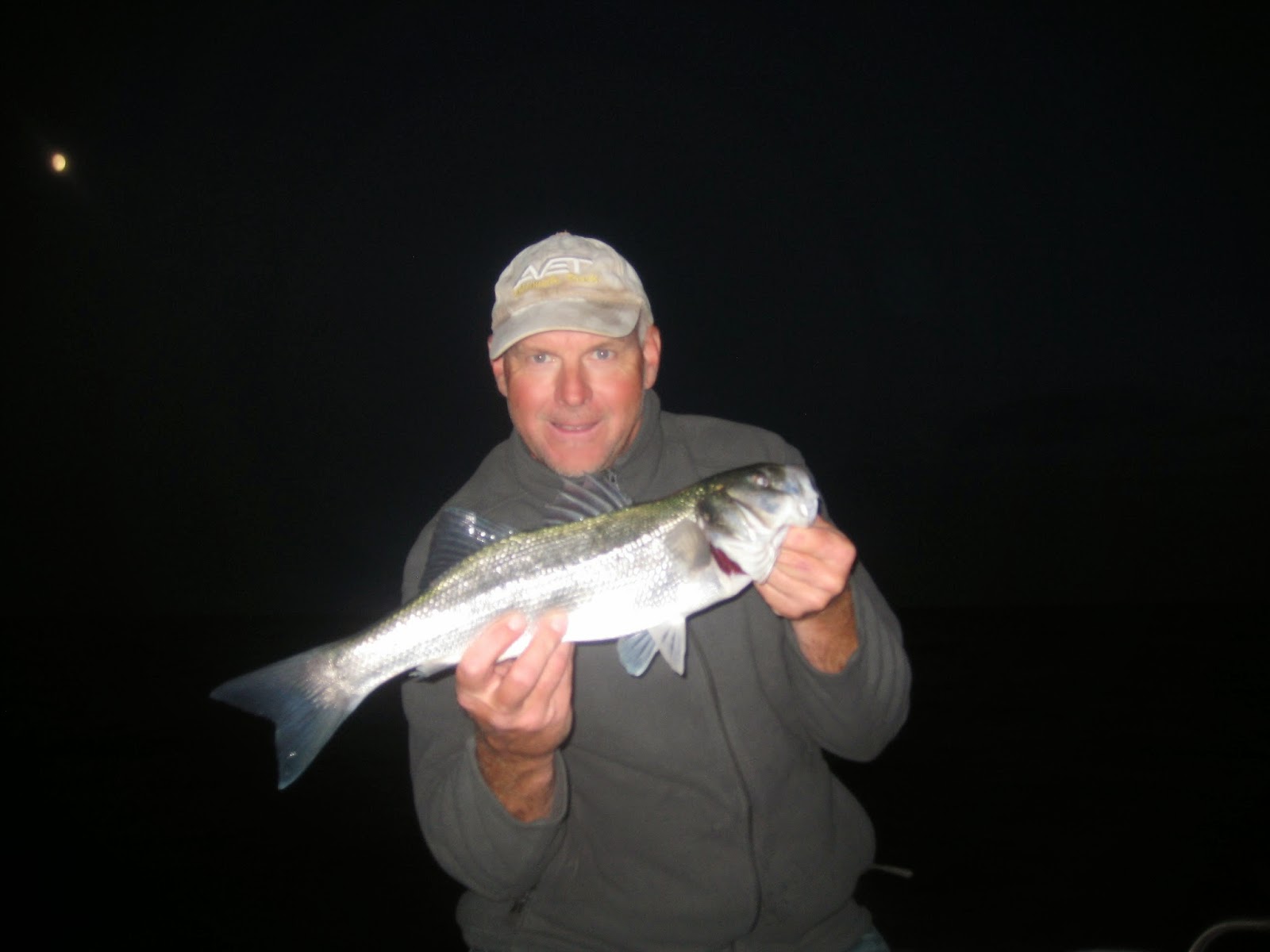 Shortly after and a far more delicate take, again to my half mackerel, produced something considerably bigger, and stronger- a good conger was 'on'. The fight was exciting with plenty of line stealing dives but not too prolonged, my main concern being to get her well away from the snags as soon as possible.
Once on the surface it was clear that I'd scored another good 6-7ft eel and the decision was made to bring her on board for weighing. At 58lb she is indeed my personal best conger-a slimmer fish than Simon's of a few days ago but pleasing nonetheless.
Brian had been unlucky with a break off when his braid parted on something abrasive but eventually connected to his own eel to maintain an even keel and I was more than happy with this. Finally another undulate took my bait before the tide lost its pace just around midnight -time to 'call it' as we both had work in the morning.
So, another successful trip to the 'new' mark for eels and an end to a very long , but highly enjoyable day, and night on the water.
 If you've enjoyed reading the blog,please take the time to leave a comment or join as,a follower. If you have any qusetions, i'd be more than happy to help.
Firstly, I took my wife out on a short afternoon trip primarily to teach her some vertical jigging with soft plastic lures over one of our local reefs but, as this only produced one small pouting, we decided to anchor up on some mixed ground. Alas just one small tope showed up on a mark that produced an endless supply this time last year.
Another target was mullet , anchoring the boat in the river on the ebb tide and trotting bread flake-the first time i've tried this from the Warrior. To cut a long story short we didn't even see a mullet let alone get a bite from one and it would appear that there are very few in the main river at the moment whereas the marina is absolutely teeming with them.
A third trip, on a small tide suitable for tope, was with piking guru Jon Cook, his first trip on my boat. We tried my deep marks at the' Chair' and 'Owers ' for just three pack fish and plenty of nuisance cat shark, not exactly a blistering result and again, not a patch on last year. Perhaps the general lack of mackerel locally is having an effect.
Finally on my most recent day time trip,my friend Alex was keen to get down on the banks to drift for turbot and brill . I'd been told that one of my favourite banks had been destroyed by the winter storms but upon investigation with the sounder this appeared to be far from the case and the bank, although a slightly different shape, has retained its most prominent features in particular a ridge that causes quite a surface rip as the tide runs.
Unfortunately the target species were not found and just one nice plaice of 2 1/2lb showed up on a ragworm bait-the only fish of the trip.
I had wanted to anchor the bank and fish for blondes which i feel would have produced, but my crew was keen to persist with drifting other neighbouring banks although this proved to be equally unproductive.
Weather conditions and tide time (HW 8p.m at Littlehampton) were perfect for the mark allowing the maximum amount of fishing time in darkness on the ebbing tide.
With no wind and a steady flow the boat was accurately positioned on the first drop of the anchor leaving the main structure just 30yards from the stern. Half mackerel and cuttle baits were sent down and, as darkness fell the first 'slamming' bite to my rod produced a small bass of all things. Nice to know there are some about on this mark and food for though for future runs.
Once on the surface it was clear that I'd scored another good 6-7ft eel and the decision was made to bring her on board for weighing. At 58lb she is indeed my personal best conger-a slimmer fish than Simon's of a few days ago but pleasing nonetheless.
Brian had been unlucky with a break off when his braid parted on something abrasive but eventually connected to his own eel to maintain an even keel and I was more than happy with this. Finally another undulate took my bait before the tide lost its pace just around midnight -time to 'call it' as we both had work in the morning.
So, another successful trip to the 'new' mark for eels and an end to a very long , but highly enjoyable day, and night on the water.
If you've enjoyed reading the blog,please take the time to leave a comment or join as,a follower. If you have any qusetions, i'd be more than happy to help.Thursday, 31 July 2014
30/7/14 Jupiter Gets The Beast


With the possible exception of tope,and perhaps a very rare Sussex/Hampshire shark, very few species will 'tug your string' with so much enthusiasm and I think that detractors of this wonderful fish are missing the point somewhat.
Previous night trips to my newly discovered mark (new to me anyway)had been restricted, time wise, by work commitments and i was desperate to give the venue more time and fish through the night -the prime feeding time for these big eels. I was also curious to see how the venue would fish on the bigger tides, my previous forays being restricted to neaps. Joining me on the trip was my mate Simon who ,in the past,has brought good luck and had some terrific trips with me on 'Jupiter'.
Simon hadn't fished for conger from a boat before, had only caught one 'strap' fish from the shore, and his biggest capture of any specie of 17lb so, I felt pretty confident we had a good chance of improving on that score tonight.
He also had to borrow some kit for the job from me and, the only suitable right hand wind reel I had in my collection was a 1960's Penn Long Beach which i'd loaded with 50lb braid.
Leaving port at 1730 in order to catch the last of the ebb over the bar at the river entrance we spent a few fruitless hours trying to catch bass on lures with just one lost fish to show for our efforts. I suspect that they may have moved close in to the inshore reefs now because friends are catching them in good numbers on marks so shallow i can't even risk getting my Warrior anywhere near them.
As the light began to fade, I 'called it' and we headed for the conger mark for the 'real 'fishing to begin.
I hadn't fished the structure on a flooding tide and it soon became apparent that the flow was weaker , and less predictable in this direction not helped by a North Westerly breeze which continually pushed the boat off line.
Simply put, our baits just weren't where i wanted them to be and this was reflected by a distinct lack of action.I think we both had one tentative take each.
I needed to pull something out of the hat and, as the tide turned and settled into the ebb the boat held steady exactly where I wanted her to be,just yards off the North east corner of the structure. Almost immediately something started to pay attention to our half mackerel baits-we'd already been out for six hours and finally had a bite!!
First fish up however,wasn't a conger, but a nice 12lb undulate to Simon's rod-the only other specie apart from conger that I've seen from the area.
At about 1-00 a.m Simon responded to a finicky take (rarely do these eels take the bait with any enthusiasm)and his rod bent into something a bit special.
Luckily the old Penn reel had held up well and with a show of considerable angling skill on Simon's part, twenty minutes or so later , he had his prize at the side of the boat. During the battle I hadn't been idle, catching and 'T barring' a fish of my own of about 20lb. Being something of a gentleman, Simon rarely uses expletives but they were flowing with aplomb when he caught sight of his fish as it was truly huge.
We both agreed that she would have to come aboard for a proper 'weights and measures' session, and the cockpit was quickly prepared to receive the beast.
Neatly chin gaffing the eel, with a firm two hand grip and a swift 'heave' she easily slid over the Warrior's rounded gunwhale , and was brought on board in one clean movement. With her head touching the inner transom, and her tail well and truly planted between the seats she literally filled up the boat- a huge fish.
The chin gaff proved to be an excellent idea enabling us to easily control the fish for pictures and subsequently 'lead' her head into the shark sling which was used for weighing. Once her eyes were covered we slipped the gaff and she became quite docile allowing us to straighten her out for a measure.
A fish in stunning condition , she was exactly 7 feet long and after subtracting the weight of the sling, weighed 72lb, annihilating Simon's previous best fish weight by 55lb.
The sling also proved to be invaluable when returning the conger as she slid back easily , majestically gliding down into the clear water- a fantastic sight that we shall both surely never forget.
I caught two more lesser congers to about 40lb and we also got snagged by a fish each before calling a halt to proceedings as the sky lightened at 4am.
The ride home was a breeze at a steady 18kts on a calm sea and, standing to helm , my eyes quickly adapted to the half light giving me a clear view of any potential hazards- a really useful aspect of the Warrior.
Once again Jupiter comes up with 'the goods' and it would appear that there are some very special conger living on this mark. Some of those we've lost in the past could have been big fish too and I think it will take a few more runs to unlock its secrets.
I did spend some more time mapping the mark prior to dropping the anchor and now have several waypoints on the plotter showing the layout of the structure and the extra knowledge gained about the tides will prove invaluable when planning future trips.
26/7/14 Hunting Mackerel
 A full set for 'the boy'
The word on the 'street' at the moment is that there is a distinct lack of mackerel about in our local waters-a worrying situation to say the least.
Out at sea it's a subject that is constantly brought up over the air waves with everybody trying desperately to find some for bait, swapping locations and following up catches usually for just a handful of fish .
I use an awful lot of them myself for bait at this time of year for shark, tope conger and of course bass , and its essential for me to have a decent frozen stock. I even have a dedicated 'mackerel' freezer in my garage.
It's always great to get my son Jack out fishing in the boat-something we do together all too rarely nowadays. He'd just returned from a six week trip to North America and was able to spend a couple of days with the 'old man' before returning home to North Devon.
With limited time , we decided just to target mackerel on a short trip , something that's always good fun and for my part,something of a necessity. The problem is that they're extremely hard to find -my plan being just to head due south from the river entrance stopping every mile or so until we found them...hopefully.
To cut a long story short, we did find them, forty six of them to be precise and a good size too but, we had to travel five miles out before they showed in any numbers. Almost too valuable to eat, four were smoked up for lunch and the rest of this most precious commodity were consigned to the bait freezer. Listening to the radio , the quality of the general fishing was quite poor however, a certain marina neighbour did fill his boots somewhat with various flatfish and rays from the local sand banks-noted for the future.
22, 24/7/14 Nocturnal Meanderings

What aroused my curiosity most about these tales, was the nature of the mark fished. Dave could only remember its rough location by the position of certain land marks, although he did recall that the fishing took place relatively close to the shore in shallow water, so close in fact, that on calm nights engine noise from road vehicles could clearly be heard.
I decided to delve deeper but , after poking my nose around locally and asking a few questions, it would seem that the particular mark ( I did, by now, have a reasonable idea of what and where it was) had been somewhat forgotten. Coincidentally, my bass fishing buddy Pete had been Mike's regular crew mate in his younger days, but even he had no knowledge of the mark.
Eventually, it was a diving manual that came up trumps , including some very encouraging information about the resident fauna, although the location details given were hopelessly inaccurate.
There was nothing for it but to have a trip out and investigate, combining the facilities provided by those two most excellent of 'gadgets'-the GPS chart plotter, and the fish finder.
I will say at this point that , to date, I've haven't actually found the exact location of Mike Pratt's supposed mark. I say 'supposed' because I suspect that Mike, and I might be completely 'off the mark' here, may have disguised the exact location to his clients, by giving it a somewhat misleading name, and I can't say I blame him at all.
It took quite a bit of scanning the area in the fading light to actually find the structure we were looking for but eventually, the plotter screen filled up with a selection of waypoint marks and built up a picture of where we needed to place our baits.
I judged my first drop of the pick in the ebbing tide to be slightly off line, so re-anchored enabling us to get our baits as close as we dared and this proved to be exactly the right move as it resulted in an immediate take and a very dark conger to my mackerel head of about 20lb-a good start.
Five more conger showed up in the short two hour session with Dave picking up the best- a fish of close to 50lb would be my best guess. Dave's remark;' It's got a head the size of a labrador' gives a more descriptive indication of its size.
Standard tope traces were used of 150lb mono with 9/0 circle hooks on the end that counts, and these proved to be easily removed, with the conger still in the water, using a 'T' bar.
Two nights later we returned for another short session to exactly the same location although we were delayed slightly by having to fix a loose electrical connection on the boat before leaving, and further delayed by giving a jet skier with a flat battery a tow back to the public slipway.
If said jet skier hadn't been a friend of mine, I'd have probably ignored his call for help (just kidding).
Six fish hooked on this trip resulted in just two to the boat on my rod of around the 20lb mark . The remaining four takes had broken us by leading us into some heavy snags down below and we both felt that they were fish of a much bigger stamp.
Interestingly, no other species were caught and there was very little interest shown in our baits from 'lesser' fish.
Whether Dave's 70lb conger from the past came from here, we'll never really know for sure but, it would appear that we have come across quite a decent mark for conger fishing, and one that definitely warrants further investigation.
Thursday, 24 July 2014
21/7/14 British Bonefish.

They are the specie that got me back into fishing after a twenty year lay off, they fight like tigers and are particularly handsome looking. Some would say they are the U.K equivalent of the veritable bonefish-a quarry i'd certainly like to have a bash at myself one day.
The marina is full of them and they usually start to appear in the early spring under the pontoons and boats. Some of them are quite big too and I have, on occasion, sneaked a little go at them, cloak and dagger fashion from my boat with some success, albeit against the marina rules. What's far more appealing however, is to take a trotting outfit, complete with 1960's Young's Trudex centre pin reel,home made cork on quill avon float, and a bucket of mashed bread, up to the open river at low tide and float fish downstream to 'spotted' fish.
My favoured time is just as the tide is slackening, so the flow isn't too fierce, and to fish the bait at a rod length out in a couple of feet of water .
The mullet aren't quite as sizable as those found in the marina(this one went 3lb 2oz) but they still put up a spirited fight and provide a superb angling challenge. I only had the one today, in a short session of around a couple of hours in the hot, midday weather conditions which are usually not too favourable for catching mullet. A few missed bites also occurred over low water slack when they have more time to inspect the bait and generally are more finicky in nature so it was entertaining fishing.
13/7/14 Back On The Shingle Again.

Fishing isn't always about catching loads of fish-well it isn't for me anyway and, because i rarely catch 'loads' of fish , i feel more than qualified to make that comment.
Very few of my boat owning colleagues, with the exception of Clive who should be considered to be a true 'allround' sea angler,fish from the sea shore. In a way, having the luxury of being able to fish afloat 'spoils' you and sea fishing on 'terra firma' becomes hard work.
It's a fact, that catching from beaches and rocks is more difficult and i would certainly class it as more challenging but no less enjoyable. It's certainly a lot simpler and cheaper than fishing afloat.
I've been trying, unsuccessfully , to catch a shore stingray of late-something i've wanted to accomplish for many years. A return to Simon's mark produced a stonking bite that failed to connect .A trip to Clymping with Jim Campbell, who has quite a bit of experience with the specie in this locale, failed to hit the target but the feisty smoothound above took a shine to my big ragworm baits providing an entertaining fight in the process and reminded me how much fun beach angling can be, particularly in darkness.
A welcome sight indeed and, as I've had some pretty spectacular smoothound catches on local beaches in the past, albeit somewhat sporadic in nature,worth bearing in mind over the next few tides sets. Three of us took thirty one night from the back of my house in August 2008 but, it's definitely a case of, there one night, gone the next.
Dave and me also ventured to Bracklesham, which has a formidable hound reputation, and watched as an angler just a couple of groins away, filled his boots with half a dozen whilst we blanked.That's the way it is sometimes.
Approach shore angling with realistic expectations and you will enjoy the experience and somehow a shore caught fish feels more worthy than one captured afloat.

Tuesday, 15 July 2014
8/7/14 A New Tope Mark
The tope fishing locally has been a little disappointing this year with few big fish showing up in catches. I'm still a little confused as to whether the big fish appear early, or late in the season but will assume that it will still be worth targeting them until September on the Selsey marks.
Dave joined me on this one and we immediately headed to my 100ft mark at the chair but, apart from the odd pack tope, the omnipresent cat sharks were in excellent bait stealing form, although a couple of rays did make an appearance.
A move was in order so I decided to try a previously unexplored mark, noted on the plotter as 'Owers Tope'.
I've no idea where the numbers emanated from though I suspect they formed part of a generic list that everyone on the marina seems to gets hold when they start out.
To cut a long story short the mark did produce a few tope, and not a bad size with perhaps a couple getting close to the 30lb mark and will be logged for future small tide outings.
I've been busy with boat maintenance issues of late. Following the Devon trip and before 'Jupiter' was returned to her mooring, I gave her hull a fresh coat of antifoul paint, a job that I'd not been looking forward to.
The existing paint is 20 months old and has held up well probably because every time I drag her out for a shark trip, I give her 'bottom' a thorough good going over with the pressure washer, but there were areas that were wearing a bit thin and needed attention.
With high winds forecast for a few days , but fine dry weather, it seemed like an ideal time to get on with the job in hand and not wait for the winter, traditionally the time for doing this sort of thing.
In the end it was actually quite an easy task and was carried out quickly and efficently by jacking the boat on axle stands whilst keeping the trailer in place and , after a quick polish, she was back in the water again. Job done. The Warrior is proving to be a very easy boat to live with.
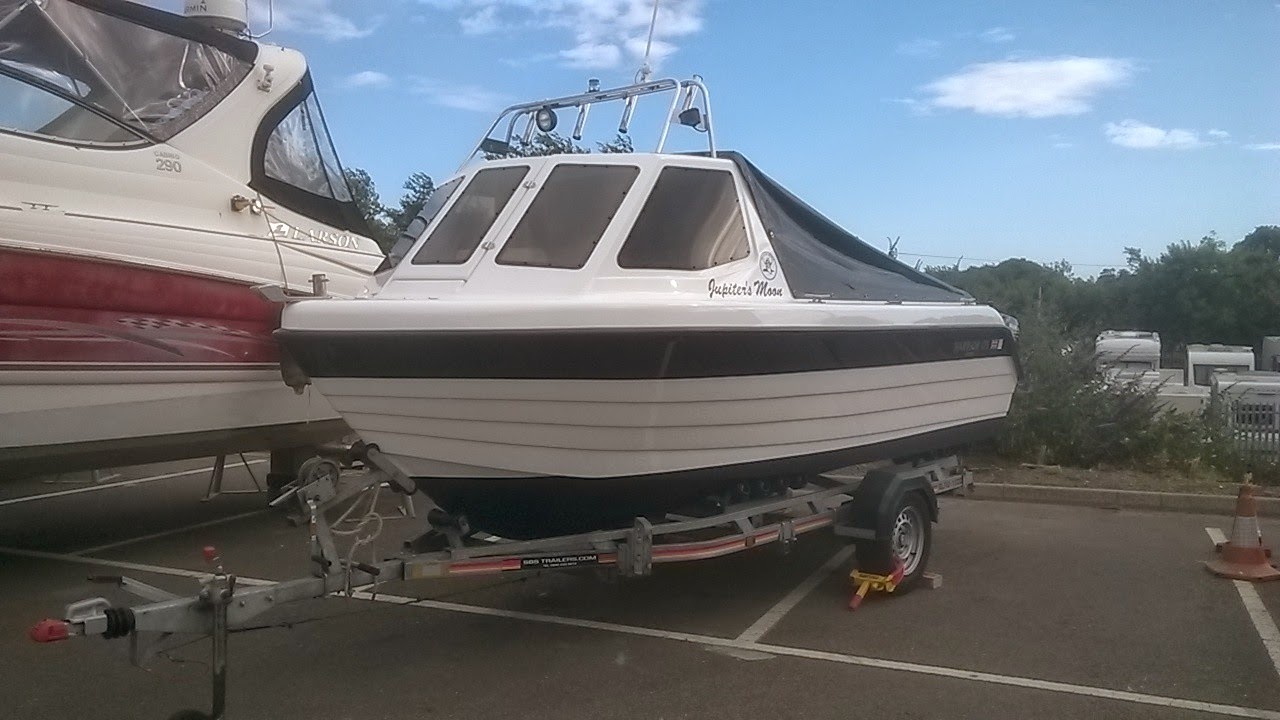
Dave joined me on this one and we immediately headed to my 100ft mark at the chair but, apart from the odd pack tope, the omnipresent cat sharks were in excellent bait stealing form, although a couple of rays did make an appearance.
A move was in order so I decided to try a previously unexplored mark, noted on the plotter as 'Owers Tope'.
I've no idea where the numbers emanated from though I suspect they formed part of a generic list that everyone on the marina seems to gets hold when they start out.
To cut a long story short the mark did produce a few tope, and not a bad size with perhaps a couple getting close to the 30lb mark and will be logged for future small tide outings.
I've been busy with boat maintenance issues of late. Following the Devon trip and before 'Jupiter' was returned to her mooring, I gave her hull a fresh coat of antifoul paint, a job that I'd not been looking forward to.
The existing paint is 20 months old and has held up well probably because every time I drag her out for a shark trip, I give her 'bottom' a thorough good going over with the pressure washer, but there were areas that were wearing a bit thin and needed attention.
With high winds forecast for a few days , but fine dry weather, it seemed like an ideal time to get on with the job in hand and not wait for the winter, traditionally the time for doing this sort of thing.
In the end it was actually quite an easy task and was carried out quickly and efficently by jacking the boat on axle stands whilst keeping the trailer in place and , after a quick polish, she was back in the water again. Job done. The Warrior is proving to be a very easy boat to live with.
Sunday, 13 July 2014
30/6 and 2/7/14 The Elusive Porbeagle Shark.


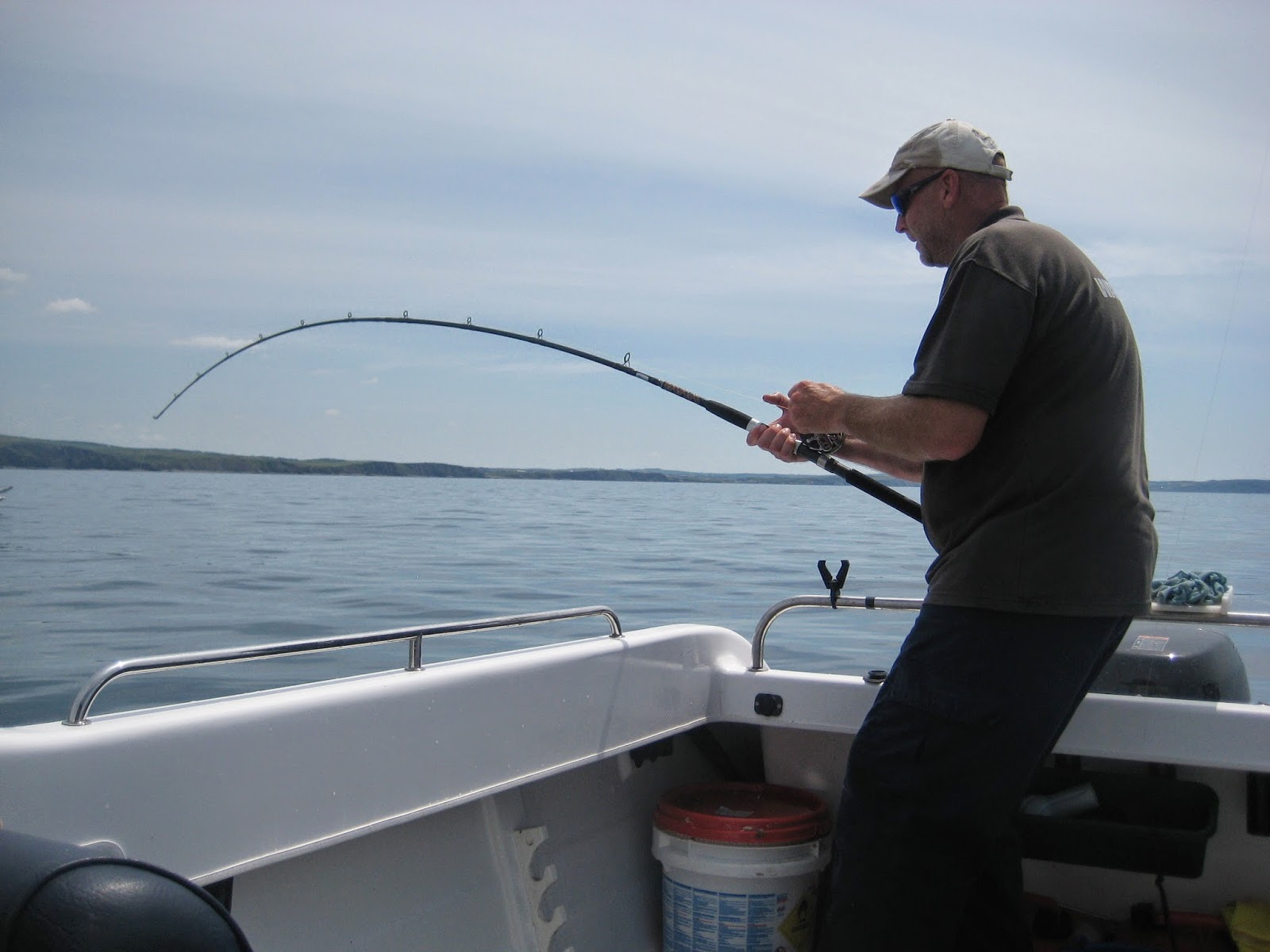


.Elusive indeed as once again, despite perfect conditions over two days fishing, I failed to find them.

Joining me on both days was my good friend , Ilfracombe local, and excellent crew Nick 'Pix' Dabney . Having dropped the boat on the visitor's mooring the evening before our first day's fishing, Nick suggested that we might nip out of the harbour and catch some mackerel for an hour or two. Joining hi us for the trip was Nick's mate, Keith. Back home in Sussex , mackerel aren't exactly plentiful this summer but the same cannot be said at Ilfracombe where the sea is absolutely teeming with them. Within a hour we'd filled the cool box with a least a hundred and the campsite freezer was commandeered later that evening so I could at least take some back home to Sussex.
We covered a massive amount of ground on the two days shark fishing from just south of Hartland down to the radar dishes and caught plenty of Pollack, and even more tope, some of them of a decent size approaching 40lb. Back home this sort of fishing would be regarded as superb but, it was simply not what we were there for. At times the tope were so thick on the ground (see the picture of the sounder screen) that we failed to get all our shark baits out before a run occurred and tope regularly followed a hooked fish up to the boat. Sometimes we were looking at four or five fish in the water beneath the hull, quite a sight.
Nick did try to tempt one with a lure and indeed dropped a shad right on to the nose of one of the 'followers' . It approached the lump of plastic, then casually turned away and here, there is a lesson to be learned. Perhaps tope do have slightly more discerning tastes than other species otherwise we would see more of them caught on lures.
Evetually we succumbed and decided to enjoy the tope fishing by scaling down our gear to normal boat rods and actually fishing for them. I have to say that catching them on the drift, just a few feet off the bottom is an engaging way of tackling these superb fish and something I'd be keen to try locally.
A couple of rather interesting sightings also took place during this trip. On three separate occasions Nick and me spotted tuna jumping. Yes, you did read that correctly. At first we weren't sure, but after the third sighting we don't think it could have been anything else- a fish of probably double figures. Incredible.
Secondly, we had a sunfish follow the boat for some time which was also a pretty incredible sight. A curious creature which we at first mistook for a shark fin on the surface.
So, despite failing to achieve the target specie, the trip was no less enjoyable and the fishing quite exciting. I learned a good deal more from the navigational point of view and now feel a little more confident negotiating a journey that frankly, this time last year, I was actually quite dubious about undertaking.
I will return.....soon.
25/6/14 Saved By The Bank


Tides were small and therefore favourable for a trip to the marks off of Selsey Bill for another tope hunt. Joining me on this one was my colleague Steve who had never before caught a tope and is usually found teasing the River Arun mullet.

We did pick tope up from the 100 foot depths at mark #41 but they were all pretty small 'pack' fish which, despite my crew's enthusiasm, I'll admit I was a little disappointed with. The big fish just haven't shown up much this year.
A move closer to the 'bill' to a recommended hound mark just produced a succession of bait robbing pouting so I decided to seek out a gully between a wreck and sand bank at #21- a mark kindly donated to me by Neil and one that I'd been meaning to try for some time.
What showed up here were blonde rays, and some nice ones too, another first for Steve who had thoroughly enjoyed his trip out on 'Jupiter' and, I guess,at the end of the day, that's all that matters.
19/6/14 Superbassing


I left the mooring about 6 a.m for this one on a very still morning and headed straight for one of my favourite reef marks with lure rods at the ready. With no other boats even out of the port , I had the sea to myself-perfect bass hunting conditions.
On arriving at the mark it was plainly obvious that the bass were indeed present , as the bird activity was 'manic' and the sounder particularly busy.I started off fishing a soft plastic swat shad vertically and it was a fish a drop from the start, averaging about 2-4lb.
Every now and again the surface of the sea would erupt as the huge shoals hit the surface, the birds giving away the exact location, signalling me to approach with 'stealth' and break out the surface plugs.
Using a 'walk the dog' patchinko, the action was again 'fast and furious' with the lure sometimes barely moving a yard or two before being savagely hit by the bass. Interestingly when I changed lures to a 'skitterpop' they seemed to show less interest although I did still hit a few.
All this went on for a couple of hours as I continually drifted the mark and held on to the massive shoals losing count at around 50 bass boated-fantastic fishing indeed.
Eventually another boat showed up following my drifts and, for a while at least, I continued to catch but, as the wind began to pick up and the tide dropped, the action waned and I decided to drop the pick and fish with baits.
Planting myself on the edge of reef #6 having picked up some welcome mackerel baits on the way it was, once again, a bite a drop. Three double figure undulates, a thornback and a couple of tope showed in a short space of time keeping me occupied to say the least even though I was hoping for a bit of a rest after the hectic morning I'd had thus far.
Occasionally we( there were two other boats on the mark) became shrouded by thick fog which enforced an eerie silence broken only by the splashing of those surfacing bass shoals somewhere in the murk.
Another move resulted in dropping the anchor at the, very snaggy 'lump' at mark #9, a mark I've not fished at anchor before. Bream were on the menu and some very good ones too with the one pictured above at 3lb the best of the session and kept for my old mate Ted Overington who was fishing nearby and wanted a nice one for tea. Some nifty work passing the fish from boat to boat in the landing net saw to that.
An excellent days fishing all told and one that I'm unlikely to forget mostly ,of course , for the bassing as It's a rare thing to immediately stumble across a good shoal like that.
I'm no great bass angler but I have two very good friends at the marina who do very well indeed with them ( as they do with other species too)
Having bass fished with both of them it's clear to me that there are no secrets to their success, no special marks or methods, just an intimate knowledge built up over years of where the bass 'could' be found. The rest is down to patience and searching. Simple really.
14/6/14 Sting Ray
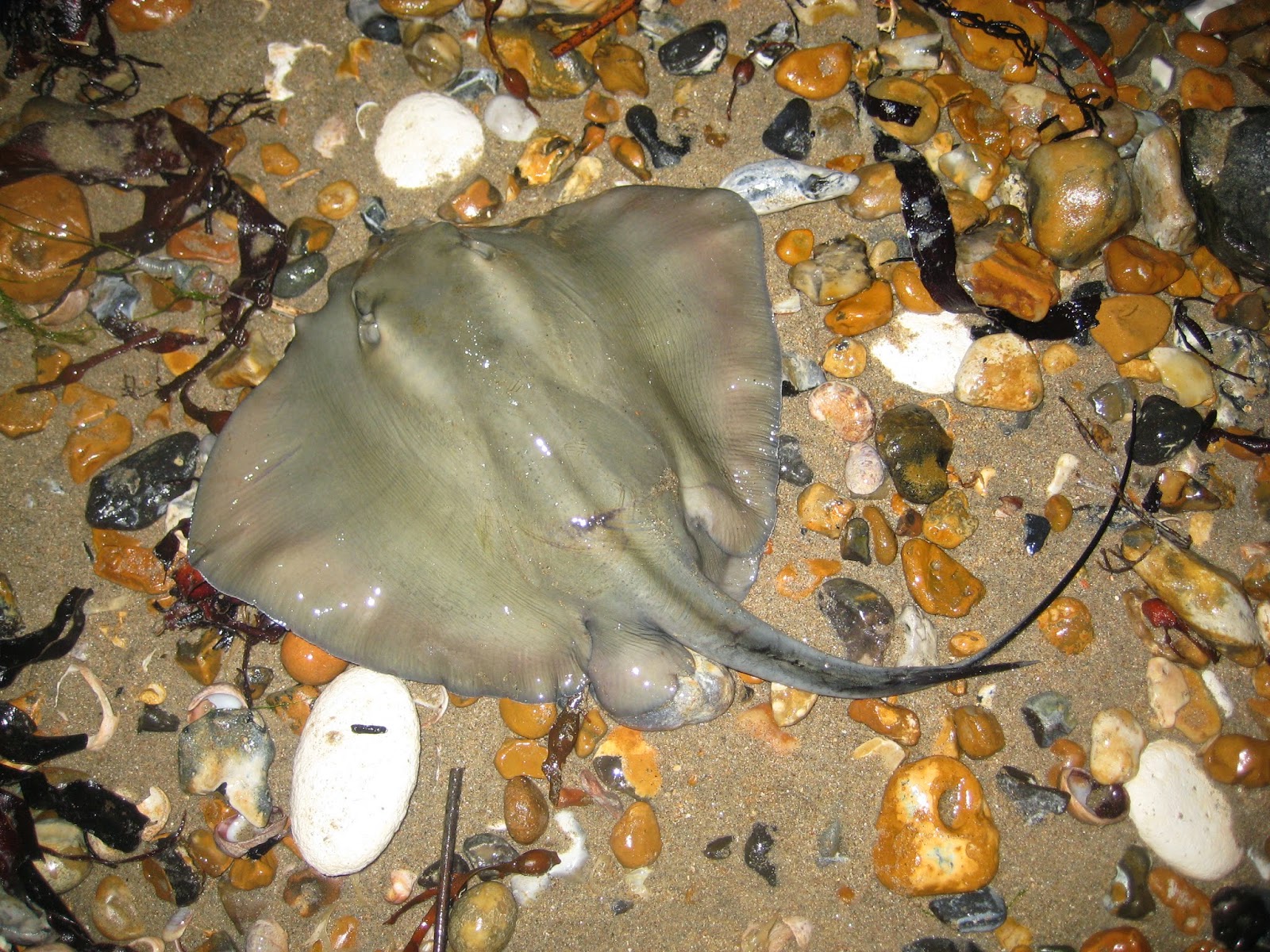
I've wanted to catch a sting ray for several years and usually plan to target them at this time of year each season. So far they've eluded me but my good mate Simon Thurgood has done a little better.
Simon had not caught a Stinger for 20 years until this week, and then he goes and get's three from the same mark, two of which he had on tonight's tide-the first time I've ever actually seen one of these curious looking fish.
The first fish was a double followed by the cute little fellah in the picture which probably weighed about 4-5lb, and because it's glue like slime hadn't attracted any sand or stones to spoil it's look, made for a nice shot.
Bait was rag worm although Simon tells me he's also had them on fish baits and squid.It's actually quite fun being back out on the shingle, something I do all too rarely nowadays , and I shall continue to seek my target over the next few weeks.
Friday, 20 June 2014
12/6/14 The Year Of The Undulate

It's possible that, because commercial fishermen are no longer allowed to land these rays , the stock is seeing something of a revival and this is indeed a popular opinion.
Personally, I think that, like many species , population levels alter randomly over time and one only has to look at the large numbers of smoothound showing in the past two decades locally to see that this can be the case.
In the 1980's a smoothound was virtually unheard of and yet, they are now one of the most popular shore species in our locale. Undulates are prevalent at the moment,so much so, that beach anglers are targeting them so perhaps their time has now arrived.
Whatever the case they are a generally quite a big fish, stunning to look and well worth the catching.
Sunday, 8 June 2014
8/6/14 Time For Tope


As it happened, although because of work commitments today was very tight for time, it was a far better day to be out. Constant sunshine and a glassy sea made for fast travel times and i think Dave and me made the most of the available fishing time.
Mackerel are extremely difficult to locate at the moment so, not wishing to waste valuable toping time, big frozen half baits were the order of the day on 9/0 circle hooks attached to heavy mono.Wire and j hooks for tope are very much a thing of the past in my boat.
Sport started shortly after dropping the anchor to the bottom of the 100ft 'trench' and remained steady whilst the tide was moving, only slowing during the slack water period. Twenty eight feisty tope came to the boat in just over five hours fishing, pretty much all double figure males with a smattering of 'twenties' to boot.
Bites were sometimes finicky and difficult to hit which is unusual for these fish and all but one was cleanly hooked in the scissors-the majority being easily released by 't' bar at the side of the boat. Selecting larger baits kept most of the cat sharks at bay though a few managed to get themselves hooked and on three occasions tope could be seen either chasing a dog, or just a retrieved bait right up to the surface.
I'm hoping that in future trips, which are limited to sub 5m tides,there'll be an opportunity to encounter some of the bigger tope similar to those that i had last year.However, usually these show earlier in the season and are replaced by the pack fish as the summer progresses.Let's hope that's not the case this year and when the mackerel do eventually arrive, the big tope follow.

Saturday, 7 June 2014
4/6/14 Back On The Bass
Along with my mates Clive and Pete, Martin is probably one of the most experienced and successful lure bass anglers amongst our local 'group'. Their catches reflect their ability and mine, by comparison, are decidedly 'average'. Sure I get a few fish and good ones too but, these three are definitely a cut above the rest among the privateers.
In fact, Martin's pretty damned good at boat fishing in general so after a chance meeting on the pontoons when we found out we were both going out solo to the same mark the following morning, I jumped at the chance of his invite to jump aboard his boat and join him.
We'd both agreed it was to be a lure only early morning session mostly to avoid the worst of the weather, which was due to turn around lunch time and, although I'm not good at getting up really early in the morning , according to the bass 'gurus' this is the time to be out there fishing.
We met on the pontoons at the 'reasonable' hour of 5a.m and headed to the mark on a very flat sea.
To begin with, the fishing was slow.........very slow. Martin took a few wrasse and to be honest, at that point, if I'd been out there on my own I'd have chosen to move to an alternative location.
This was to be my first lesson. Martin was confident that, although the bass weren't giving themselves away on the sounder, they were present, and would at some time choose to feed. We persisted by continually drifting the same area bouncing our soft plastic lures along the sea bed,even though the tide was dropping away, again not normally what I would choose to do, and eventually Martin was proved to be right.
Not big bass-most in the 2-3lb class but great sport and very consistent.
Gradually the fish began to show more regularly on the sounder , and in a denser configuration especially as the tide speed reduced.
Occasionally the shoal would appear on the surface often for several minutes. It was calm enough to see this occur but bird activity more than gave away their location, and once we'd moved the boat close enough without spooking them,it was time to hit them with hard plastic surface 'Patchinko' lures which seemed to kill on almost every cast until they would suddenly sound, and disappear for a while.
By mid morning the tide , although quite small, was flooding hard enough to make vertical soft plastic fishing all but impossible, and the wind had whipped up anyway so we decided to call it a day but not before Martin winkled out two decent sized fish in the 5-6lb bracket just for good show. Interestingly as the tide pushed hard, less evidence of the shoal was seen on the sounder and most of the fish caught were when the lure was fished hard on the deck, whereas during the slacker periods the fish could be taken well up in the water on a retrieve, or on the drop.
My theory is that they may have spread out over the mark with their heads down during this time and therefore become a little more difficult to locate, especially as we were struggling to keep the lures on the bottom.
We very quickly lost count of what was coming aboard and a conservative estimate would be fifty bass to the boat at least.
Martin chose to return all of his but I decided to take three for the table two of which were prepared as 'Cerviche'. Quite simply, the fish is filleted and cubed then marinated in lemon and lime juice with tomatoes, chilli and tabasco. The first time I'd actually eaten 'raw' fish and it was quite stunning.
So what did I learn? Well, lets just say it's given me plenty to think about but foremost was Martin's patience and confidence in the mark .
The location itself is not unknown to me nor anything special and, as I'd said, is one that I'd regularly visit. Out of respect for Martin and one of our charter skippers, who also uses the spot on occasion, I won't even quote it by number. I'm unlikely to forget it anyway.
The main difference due to his experience is that Martin seemed to know exactly what the bass would do on the mark at any given time. He knew they were there, or indeed were likely to be there, as he'd caught them in the preceding days and therefore despite them not initially co-operating he decided to stick it out and this paid off.
When I think back to my own trips to known bass marks where I've thought they just weren't present and therefore moved on, it does make me wonder if they'd been there all the time but were just not up for it. The only way to find out is to go back and try!


If you've enjoyed reading this blog or have any comments and questions please feel free to email me at completeangler@sky.com.
In fact, Martin's pretty damned good at boat fishing in general so after a chance meeting on the pontoons when we found out we were both going out solo to the same mark the following morning, I jumped at the chance of his invite to jump aboard his boat and join him.
We'd both agreed it was to be a lure only early morning session mostly to avoid the worst of the weather, which was due to turn around lunch time and, although I'm not good at getting up really early in the morning , according to the bass 'gurus' this is the time to be out there fishing.
We met on the pontoons at the 'reasonable' hour of 5a.m and headed to the mark on a very flat sea.
To begin with, the fishing was slow.........very slow. Martin took a few wrasse and to be honest, at that point, if I'd been out there on my own I'd have chosen to move to an alternative location.
This was to be my first lesson. Martin was confident that, although the bass weren't giving themselves away on the sounder, they were present, and would at some time choose to feed. We persisted by continually drifting the same area bouncing our soft plastic lures along the sea bed,even though the tide was dropping away, again not normally what I would choose to do, and eventually Martin was proved to be right.
Not big bass-most in the 2-3lb class but great sport and very consistent.
Gradually the fish began to show more regularly on the sounder , and in a denser configuration especially as the tide speed reduced.
Occasionally the shoal would appear on the surface often for several minutes. It was calm enough to see this occur but bird activity more than gave away their location, and once we'd moved the boat close enough without spooking them,it was time to hit them with hard plastic surface 'Patchinko' lures which seemed to kill on almost every cast until they would suddenly sound, and disappear for a while.
By mid morning the tide , although quite small, was flooding hard enough to make vertical soft plastic fishing all but impossible, and the wind had whipped up anyway so we decided to call it a day but not before Martin winkled out two decent sized fish in the 5-6lb bracket just for good show. Interestingly as the tide pushed hard, less evidence of the shoal was seen on the sounder and most of the fish caught were when the lure was fished hard on the deck, whereas during the slacker periods the fish could be taken well up in the water on a retrieve, or on the drop.
My theory is that they may have spread out over the mark with their heads down during this time and therefore become a little more difficult to locate, especially as we were struggling to keep the lures on the bottom.
We very quickly lost count of what was coming aboard and a conservative estimate would be fifty bass to the boat at least.
Martin chose to return all of his but I decided to take three for the table two of which were prepared as 'Cerviche'. Quite simply, the fish is filleted and cubed then marinated in lemon and lime juice with tomatoes, chilli and tabasco. The first time I'd actually eaten 'raw' fish and it was quite stunning.
So what did I learn? Well, lets just say it's given me plenty to think about but foremost was Martin's patience and confidence in the mark .
The location itself is not unknown to me nor anything special and, as I'd said, is one that I'd regularly visit. Out of respect for Martin and one of our charter skippers, who also uses the spot on occasion, I won't even quote it by number. I'm unlikely to forget it anyway.
The main difference due to his experience is that Martin seemed to know exactly what the bass would do on the mark at any given time. He knew they were there, or indeed were likely to be there, as he'd caught them in the preceding days and therefore despite them not initially co-operating he decided to stick it out and this paid off.
When I think back to my own trips to known bass marks where I've thought they just weren't present and therefore moved on, it does make me wonder if they'd been there all the time but were just not up for it. The only way to find out is to go back and try!
If you've enjoyed reading this blog or have any comments and questions please feel free to email me at completeangler@sky.com.
Subscribe to:
Posts (Atom)